Showing posts with label tomatoes. Show all posts

Sunday, May 16, 2010

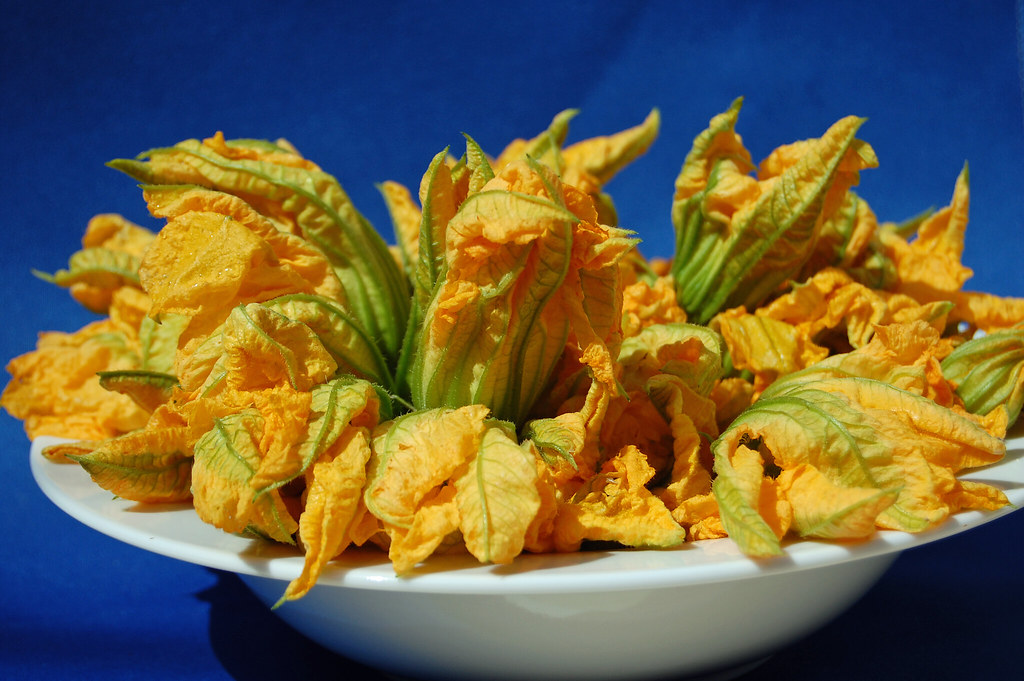
Vegan Squash Blossom Soup (Sopa de Flor de Calabaza)

This isn't necessarily the traditional way of making sopa de flor de calabaza. I've never really had the traditional version. But I do tend to have a lot of squash blossoms on hand, and I was tired of squash blossom quesadillas and tlacoyos. So I threw this together, and it was delicious.

This is a soup for gardeners, because you won't find squash blossoms (flores de calabaza) in your local gringo grocery store. Just wait until the flowers on your summer squash vines are in bloom or just opening, and snip them. I promise more will grow back and you'll still have more summer squash than you know what to do with.

Summer squash, by the way, is any squash that has a soft, edible skin. Zucchini is a summer squash, for example. Pumpkin and butternut are not.

INGREDIENTS:
  • 20 squash blossoms with stems removed, divided
  • 3 plum or roma tomatoes
  • 3/4 small white onion, chopped and divided
  • 1 chile (Your choice based on your heat preferences.  I used a serrano and it was perfect for me.)
  • 2 cloves garlic
  • 2 cups cubed summer squash
  • 6 tablespoons olive oil, divided
  • salt to taste
  • 6 cups water
  • 2 teaspoons MSG (optional)
  • 1 sprig fresh epazote or 1 teaspoon dried epazote or 1 sprig fresh parsley
  • 1/4 cup texturized vegetable protein (TVP, optional)

PREPARATION:
  1. Quarter the tomatoes and put them in the blender.  Add chile, the equivalent of 1/2 a small onion (leaving the other 1/4 aside for now), 10 squash blossoms, garlic, and blend until liquified.  Add a small amount of water to facilitate blending, if necessary.
  2. Heat 3 tablespoons olive oil in a clay pot or large pot.  Add the puree from the blender and simmer until the tomatoes are cooked (the puree will turn a darker red).
  3. While the tomato puree is cooking, heat the other 3 tablespoons olive oil in a cast iron pan.  Add remaining onion and squash blossoms and all the cubed squash.  Saute until squash is just cooked.
  4. Add the squash/onion/blossom saute to the pot with the tomato puree.  Add water, epazote, and TVP and MSG, if using.  
  5. Salt to taste and simmer ten minutes to let flavors blend.
Serve with crusty bread or warm corn tortillas.  Serves 2-3.

Thursday, April 8, 2010

Mexican Noodle Soup (Sopa de Fideo)

This soup is generally served as part of a multi-course meal.  Traditionally, it is simply pasta in tomato broth, no vegetables added.  However, last night we found some vegetables in the fridge and texturized vegetable protein in the cabinet, and we turned this soup into a meal.

Texturized vegetable protein (also known as TVP) is surprisingly easy to find in Mexico--more so than in the United States.  It's sold as "soya" in natural food stores in the Mexico City metro or in the bulk foods section of your local grocery store.

INGREDIENTS:
  • 5 plum tomatoes
  • 1/4  medium onion, roughly chopped
  • 2-3 cloves garlic
  • 1-2 dried chile de arbol OR 1-2 jalepeƱos
  • 3 cups water plus more for blending
  • 1 200-gram bag small pasta, uncooked
  • 1/8 cup canola or vegetable oil
  • 1-2 stalks fresh epazote (1 teaspoon dried) OR 2 stalks fresh parsely
  • 1 medium carrot, chopped (optional)
  • 1 stalk celery, chopped (optional)
  • 1/3 cup texturized vegetable protein (TVP)
PREPARATION:
  1. Quarter tomatoes and put them in a blender with the onion, chile, and garlic.  Add enough water to cover the tomatoes.  Blend until liquified.
  2. In a large pot, heat the oil.  Add the pasta and fry, stirring constantly until it begins to brown.  As soon as it begins to brown, add 3 cups water and contents of blender.  Stir to make sure no pasta is sticking to the pot.
  3. Add epazote or parsely.  Add vegetables and TVP, if using.
  4. Cook until pasta and vegetables are thoroughly cooked and TVP is re-hydrated.
  5. Serve with warm corn tortillas.
Serves 4.

Tuesday, April 6, 2010

Basil Pesto Pasta

In our rooftop garden, we grow tomatoes, chile, oregano, and basil in buckets.  Because winter is very mild where we live, we can grow a lot of the plants year-round.  We planted the basil last September, and it's still growing like crazy.  Yesterday I trimmed it back and ended up with about two cups of basil clippings.   Usually I dry what I trim and give it to friends, but this was a lot of basil.  I decided to make a pesto.

I found a tasty Pesto Pasta Salad recipe on Simply Recipes.  I didn't have all of the ingredients and neither did my local supermarket, so I did some substitutions and came up with the following pasta salad.

By far the oddest substitution must be the yogurt for parmesan cheese in the pesto.  Parmesan is very expensive in Mexico, and there's no adequate local substitute.  We make our own yogurt, and I had some in the kitchen that had been fermenting for a bit too long.  It was very, very sharp.  My husband was skeptical when he saw me at work in the kitchen, but he loved the end result, and I think you will, too.  Vegans can simply omit the yogurt entirely, or substitute it with a tablespoon of white or light miso.

We served this pasta with rustic bread and Basic Beans, Mexican Style for a very filling meal.

INGREDIENTS


Pesto
    • 2 cups fresh basil leaves, packed
    • 2 tablespoons plain, unsweetened yogurt OR 1 tablespoon light or white miso
    • 1/2 cup extra virgin olive oil
    • 1/3 cup almonds
    • 3 garlic cloves, minced
    • Salt and freshly ground black pepper to taste
    (makes about 1 cup pesto)

    Pasta 
    • 1/2 kilo (about 1 pound) uncooked penne or spiral pasta
    • 1 cups basil pesto (see recipe above)
    • 2 tablespoons chopped green olives OR olive tapenade
    • 1/3 cup chopped red bell pepper
    • 3 plum or roma tomatoes, chopped
    • 1 Tbsp olive oil
    • Salt and pepper to taste
    PREPARATION
    1. Prepare pasta according to package directions in salted water.
    2. While the pasta is cooking, combine all pesto ingredients in a blender and blend until basil leaves are pulverized and the almonds are chopped (don't worry if there's some almond chunks).
    3. When pasta is done cooking, drain.  Return the pasta to the cooking pot and add remaining ingredients.
    4. Serve warm or cold.
    Serves 6-8.

      Monday, April 5, 2010

      Scrambled Eggs al la Mexicana (Mexican-Style)

      This is a simple recipe for scrambled eggs.  I make it several times a week because of all of the Mexican breakfasts, it is by far the easiest and quickest.  That's right, I make it several times a week--here in Mexico we eat eggs for breakfast nearly every day.  And if we don't eat them for breakfast, we eat them as part of another meal.

      I added a mild option, replacing chile with green bell pepper.  It's sacrilegious, but I know that not everyone likes chile.

      Mexicans generally prepare their eggs (and all other food) in vegetable oil.  I don't like vegetable oil because it is generally at least half soybean oil (and who knows what else), which is very high in saturated fat.  Saturated fat is one of the worst fats: your body turns it into cholesterol.  While diet's role in a person's cholesterol levels is still being debated, one thing's for sure: saturated fat is not your friend.  For that reason, vegetable oil is not your friend, either.

      When I'm cooking, I prioritize two things: health and flavor.  Vegetable oil is neither healthy nor flavorful, so I never use it and you won't find it in my kitchen.  Olive oil, which I use in this recipe to fry the vegetable ingredients, is relatively low in saturated fat and contains some "good fats."  It is also very flavorful and makes a wonderful combination with the vegetables.  However, I've found that frying eggs in olive oil has less-than-desirable results.  Butter, however, is by far the best fat to fry your eggs.  It's not healthy, but it sure is flavorful!

      Another thing you won't find in my kitchen is non-stick cookware.  That stuff causes cancer.  For frying eggs, I use a heavy-duty stainless steel frying pan.  You need to use more oil with a stainless steel pan than you would with a non-stick one, but I do think it's worth it.  If you are using a non-stick pan, feel free to reduce the oil.

      INGREDIENTS
      • 2 tablespoons olive oil
      • 1-2 tablespoons butter
      • 2 plum or roma tomatoes, diced
      • 1 chile, chopped (jalepeƱo for milder eggs, serano if you want a very spicy breakfast) OR 1/4 cup chopped green bell pepper
      • 1/4 cup diced white onion
      • 5 eggs
      • salt to taste
      PREPARATION
      1. Heat the olive oil in an 8-inch frying pan over medium heat.  Don't let the oil smoke; that means you're burning it.
      2. Add tomatoes, chile, and onion.  Fry until onion is translucent.  Add a little more olive oil if the tomatoes start to stick during frying.
      3. Add butter.  Use less if a decent amount of olive oil remains from frying the vegetables; use more butter if the vegetables have soaked up a lot of the oil.  The goal here is that your eggs don't stick.
      4. Add eggs.  You can either crack them right in the pan or you can crack them in a separate bowl and beat them and then add them.  Obviously, cracking them straight into the pan is much easier.
      5. Scramble the eggs and add salt to taste before they're cooked through.
      6. Serve with warm corn tortillas and Basic Beans, Mexican Style.
      Serves 2.