Showing posts with label olive oil. Show all posts

Sunday, September 16, 2012

Homemade Onion-Herb White Bread

This bread was a hit at a recent dinner party.  You don't find too many homemade savory breads here in  Mexico, so when you show up at a dinner with one of these loaves, folks will think you're a cooking god... and you are, aren't you?

My favorite part about this bread (aside from the rave reviews that were lavished upon me all night) is that it only cost me $30 pesos, or less than $3 dollars, to make FOUR loaves.

I made two loaves in bread pans and I braided the other two loaves Challah-style.  The braided loaves were beautiful, and the bread pan loaves have made some delicious sandwiches.

INGREDIENTS

  • 2 cups soy or cows milk (I used soy)
  • 5 TB sugar
  • 2 TB salt
  • 4 1/2 tsp bread yeast
  • 2 cups water
  • 12-13 cups white flour
  • 5 TB melted butter or margerine, or olive oil
  • 1/2 onion, minced
  • 1 tsp dried basil
  • 2 tsp crushed rosemary
PREPARATION
  1. Combine milk, sugar, salt, and water in a pan and heat on the stove until lukewarm (it should feel warm, not hot, on your wrist).  Remove from heat and dissolve yeast in the mixture.  Set aside.
  2. In a very large bowl (you might even want to use a Dutch oven if you don't have a very large bowl), combine half of the flour and all of the dried herbs.  Add the liquid-yeast mixture from step 1.  Mix until smooth, then add the melted butter or oil and the minced onion. Mix until smooth, then add the remaining flour.
  3. Knead the dough for ten minutes, adding more flour if the dough is too sticky.  As you knead, your dough should be silky soft, elastic, and not sticky at all.  It should be easy to knead the dough, although you will certainly break a sweat as you knead, because the dough will weigh about five pounds!  To avoid making a huge mess on my table, I always knead my dough directly in my bowl or Dutch oven.  
  4. Oil your bowl or Dutch oven, and place your dough ball inside.  Flip the dough ball over so that the whole ball gets covered in oil.  The oil will make sure the dough doesn't dry out as it rises.
  5. Cover the bowl containing the dough with a towel and place in a warm, draft-free place.  If it's a cold or rainy day, you might need to fire up your oven for just a few minutes, then turn it off and put your dough inside to rise where it's nice and warm.  Let the dough rise until doubled in size, about 1 1/2 hours.
  6. When the dough has doubled in size, punch it down and divide it into four equal peices (I cut mine into quarters with a knife).  Shape each peice into a loaf and place either in a greased bread pan or on a greased cookie sheet.  Cover the loaves again with a towell and let them rise until double in size, about one hour.
  7. While the loaves are rising, pre-heat your oven to 350 degrees F.  
  8. When the loaves have risen, place them in the oven and bake for 45 minutes, or until the loaves begin to get a golden color and they sound hollow when you knock on them.
  9. Let the loaves cool for about ten minutes, then remove them from the pans and/or baking sheets and set them on a rack to cool.  IMPORTANT! You need to let them cool completely (about an hour) before you cut them.  This is very tricky if you don't live alone!
Makes 4 1-lb. loaves.

Tuesday, September 11, 2012

Vegan Soy Sloppy Joes

Photo: Learning Vegan
This recipe is for "Messy Mikes" from my favorite cookbook author Joanne Stepaniak's book Vegan Vittles.  She offers two versions: one made with tempeh and one with TVP (texturized vegetable protein).  I'm reprinting her TVP version here because while Mexico doesn't have tempeh, every corner store in the country seems to carry TVP (they call it "soya"), along with the rest of these everyday ingredients.  Make this recipe, and your Mexican friends will once again be so surprised at how you can use common Mexican ingredients to create such an exotic traditional gringo dish!

A note on some of the ingredients: this recipe calls for ketchup and apple cider vinegar.  If you're in Mexico, I highly suggest you work hard to find Heinz ketchup.  I found it in Sam's Club.  US-style ketchup is far superior to Mexican-style ketchup, which is so watered down that it hardly tastes like tomato at all and the color looks like orange soda syrup.  Since Heinz has more tomatoes, it's also more prostate-healthy than its Mexican counterpart.  So splurge.  You won't regret it.

This recipe also calls for apple cider vinegar.  Stay away from the grocery store, because most of those vinegars are white vinegar (you know, the kind made from wood chips) with food coloring.  I kid you not, check out the ingredients.  Traditional Mexican markets (the mercaditos) have fabulous homemade apple cider vinegar!  You'll find them at a lot of vegetable stands.  They'll be in plastic water bottles with the labels peeled off.  They'll look a lot like honey, and maybe you always thought they were honey, but they're not!  If you haven't seen what I'm talking about, go to your local mercadito and ask any vendor where they sell vinagre de manzana casero.  Store-bought vinegar will do in a pinch, but, again, the real thing is really worth the effort.  And it's just better for you.

So, without further ado, here is Joanne Stepaniak's Messy Mikes:

INGREDIENTS

  • 1 TB olive oil
  • 1 medium onion, diced
  • 1 c. TVP rehydrated with 7/8 c. water
  • 2 TB soy sauce
  • 1/2 c. ketchup
  • 1 tsp sweetener of your choice (I use sugar)
  • 1 tsp prepared yellow mustard
  • 1 tsp apple cider vinegar
  • Bread rolls (try bolillos or hamburger buns)
PREPARTION
  1. Soak the TVP in the water while you dice the onions (it should soak at least 5 minutes).
  2. Place the oil in a 2-quart saucepan, and heat it over medium-high.  When the oil is hot, add the diced onion, TVP, and soy sauce, and sauté them until the onion is tender and lightly browned, about ten minutes.
  3. Add the remaining ingredients except the bread, and mix well.  Reduce heat to medium, and simmer the mixture, uncovered, for 10 minutes, stirring often and making sure to scrape the bottom of the pan.  
  4. Open the rolls as if you were to make a sandwich and stuff them with the TVP mixture.  Serve and enjoy!

Sunday, May 16, 2010

Vegan Squash Blossom Soup (Sopa de Flor de Calabaza)

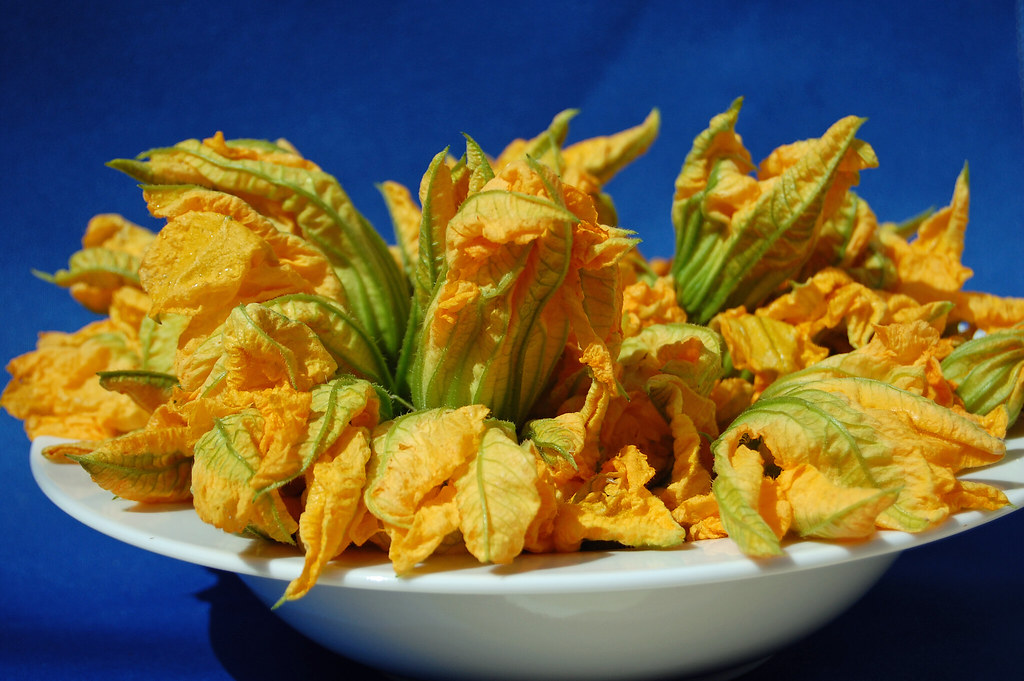
This isn't necessarily the traditional way of making sopa de flor de calabaza. I've never really had the traditional version. But I do tend to have a lot of squash blossoms on hand, and I was tired of squash blossom quesadillas and tlacoyos. So I threw this together, and it was delicious.

This is a soup for gardeners, because you won't find squash blossoms (flores de calabaza) in your local gringo grocery store. Just wait until the flowers on your summer squash vines are in bloom or just opening, and snip them. I promise more will grow back and you'll still have more summer squash than you know what to do with.

Summer squash, by the way, is any squash that has a soft, edible skin. Zucchini is a summer squash, for example. Pumpkin and butternut are not.

INGREDIENTS:
  • 20 squash blossoms with stems removed, divided
  • 3 plum or roma tomatoes
  • 3/4 small white onion, chopped and divided
  • 1 chile (Your choice based on your heat preferences.  I used a serrano and it was perfect for me.)
  • 2 cloves garlic
  • 2 cups cubed summer squash
  • 6 tablespoons olive oil, divided
  • salt to taste
  • 6 cups water
  • 2 teaspoons MSG (optional)
  • 1 sprig fresh epazote or 1 teaspoon dried epazote or 1 sprig fresh parsley
  • 1/4 cup texturized vegetable protein (TVP, optional)

PREPARATION:
  1. Quarter the tomatoes and put them in the blender.  Add chile, the equivalent of 1/2 a small onion (leaving the other 1/4 aside for now), 10 squash blossoms, garlic, and blend until liquified.  Add a small amount of water to facilitate blending, if necessary.
  2. Heat 3 tablespoons olive oil in a clay pot or large pot.  Add the puree from the blender and simmer until the tomatoes are cooked (the puree will turn a darker red).
  3. While the tomato puree is cooking, heat the other 3 tablespoons olive oil in a cast iron pan.  Add remaining onion and squash blossoms and all the cubed squash.  Saute until squash is just cooked.
  4. Add the squash/onion/blossom saute to the pot with the tomato puree.  Add water, epazote, and TVP and MSG, if using.  
  5. Salt to taste and simmer ten minutes to let flavors blend.
Serve with crusty bread or warm corn tortillas.  Serves 2-3.

Tuesday, April 6, 2010

Basil Pesto Pasta

In our rooftop garden, we grow tomatoes, chile, oregano, and basil in buckets.  Because winter is very mild where we live, we can grow a lot of the plants year-round.  We planted the basil last September, and it's still growing like crazy.  Yesterday I trimmed it back and ended up with about two cups of basil clippings.   Usually I dry what I trim and give it to friends, but this was a lot of basil.  I decided to make a pesto.

I found a tasty Pesto Pasta Salad recipe on Simply Recipes.  I didn't have all of the ingredients and neither did my local supermarket, so I did some substitutions and came up with the following pasta salad.

By far the oddest substitution must be the yogurt for parmesan cheese in the pesto.  Parmesan is very expensive in Mexico, and there's no adequate local substitute.  We make our own yogurt, and I had some in the kitchen that had been fermenting for a bit too long.  It was very, very sharp.  My husband was skeptical when he saw me at work in the kitchen, but he loved the end result, and I think you will, too.  Vegans can simply omit the yogurt entirely, or substitute it with a tablespoon of white or light miso.

We served this pasta with rustic bread and Basic Beans, Mexican Style for a very filling meal.

INGREDIENTS


Pesto
    • 2 cups fresh basil leaves, packed
    • 2 tablespoons plain, unsweetened yogurt OR 1 tablespoon light or white miso
    • 1/2 cup extra virgin olive oil
    • 1/3 cup almonds
    • 3 garlic cloves, minced
    • Salt and freshly ground black pepper to taste
    (makes about 1 cup pesto)

    Pasta 
    • 1/2 kilo (about 1 pound) uncooked penne or spiral pasta
    • 1 cups basil pesto (see recipe above)
    • 2 tablespoons chopped green olives OR olive tapenade
    • 1/3 cup chopped red bell pepper
    • 3 plum or roma tomatoes, chopped
    • 1 Tbsp olive oil
    • Salt and pepper to taste
    PREPARATION
    1. Prepare pasta according to package directions in salted water.
    2. While the pasta is cooking, combine all pesto ingredients in a blender and blend until basil leaves are pulverized and the almonds are chopped (don't worry if there's some almond chunks).
    3. When pasta is done cooking, drain.  Return the pasta to the cooking pot and add remaining ingredients.
    4. Serve warm or cold.
    Serves 6-8.

      Monday, April 5, 2010

      Scrambled Eggs al la Mexicana (Mexican-Style)

      This is a simple recipe for scrambled eggs.  I make it several times a week because of all of the Mexican breakfasts, it is by far the easiest and quickest.  That's right, I make it several times a week--here in Mexico we eat eggs for breakfast nearly every day.  And if we don't eat them for breakfast, we eat them as part of another meal.

      I added a mild option, replacing chile with green bell pepper.  It's sacrilegious, but I know that not everyone likes chile.

      Mexicans generally prepare their eggs (and all other food) in vegetable oil.  I don't like vegetable oil because it is generally at least half soybean oil (and who knows what else), which is very high in saturated fat.  Saturated fat is one of the worst fats: your body turns it into cholesterol.  While diet's role in a person's cholesterol levels is still being debated, one thing's for sure: saturated fat is not your friend.  For that reason, vegetable oil is not your friend, either.

      When I'm cooking, I prioritize two things: health and flavor.  Vegetable oil is neither healthy nor flavorful, so I never use it and you won't find it in my kitchen.  Olive oil, which I use in this recipe to fry the vegetable ingredients, is relatively low in saturated fat and contains some "good fats."  It is also very flavorful and makes a wonderful combination with the vegetables.  However, I've found that frying eggs in olive oil has less-than-desirable results.  Butter, however, is by far the best fat to fry your eggs.  It's not healthy, but it sure is flavorful!

      Another thing you won't find in my kitchen is non-stick cookware.  That stuff causes cancer.  For frying eggs, I use a heavy-duty stainless steel frying pan.  You need to use more oil with a stainless steel pan than you would with a non-stick one, but I do think it's worth it.  If you are using a non-stick pan, feel free to reduce the oil.

      INGREDIENTS
      • 2 tablespoons olive oil
      • 1-2 tablespoons butter
      • 2 plum or roma tomatoes, diced
      • 1 chile, chopped (jalepeño for milder eggs, serano if you want a very spicy breakfast) OR 1/4 cup chopped green bell pepper
      • 1/4 cup diced white onion
      • 5 eggs
      • salt to taste
      PREPARATION
      1. Heat the olive oil in an 8-inch frying pan over medium heat.  Don't let the oil smoke; that means you're burning it.
      2. Add tomatoes, chile, and onion.  Fry until onion is translucent.  Add a little more olive oil if the tomatoes start to stick during frying.
      3. Add butter.  Use less if a decent amount of olive oil remains from frying the vegetables; use more butter if the vegetables have soaked up a lot of the oil.  The goal here is that your eggs don't stick.
      4. Add eggs.  You can either crack them right in the pan or you can crack them in a separate bowl and beat them and then add them.  Obviously, cracking them straight into the pan is much easier.
      5. Scramble the eggs and add salt to taste before they're cooked through.
      6. Serve with warm corn tortillas and Basic Beans, Mexican Style.
      Serves 2.

      Thursday, March 11, 2010

      Vegan Split Pea Soup


      This recipe was inspired by Leftover Queen's Easy PEAsy Vegan Split Pea Soup.  I've tweaked it a bit and added a pressure cooker variation.  The pressure cooker speeds up cooking (reducing your gas use) and eliminates the need to dirty your blender because the pressure pulverizes the split peas.

      Every vegetarian should own a pressure cooker, and I can't stress that enough.   The pressure cooker in this recipe reduces cooking time from 40 minutes to 10.  Need I say more?

      This split pea soup has a secret ingredient: a single chipotle pepper.  A chipotle is a smoked jalepeño.  It gives the soup a smokey flavor that is reminiscent of the flavor ham would give it.  Don't worry if you don't like spicy food; it hardly gives the soup any spice.

      INGREDIENTS:

      • 3 TBS olive oil

      • 1/2 large white or yellow onion, diced
      • 
2 large carrots, diced

      • 5 cloves of garlic, minced
      • 
2 bay leaves

      • salt and pepper to taste
      • 
2 cups dried split peas
      • 
5 cups water
      • 
1 canned chipotle pepper

      PREPARATION:

      Conventional Stovetop Method:

      1. Heat oil in a large pot. 
      2. Add the onion, carrot, garlic and bay leaves. Sautee together until onions and carrots are soft. 
      3. Add chipotle pepper, peas, and water to the pot. Bring to a boil, then lower the heat and let simmer, stirring often, until the peas are soft (about 40 minutes). 
      4. Place about half of the soup in a blender or food processor and blend until smooth. Add it back to the pot and then add salt and pepper to taste. 
      5. Stir together and cook for about 10 minutes. 
      Pressure Cooker Method:
      1. Heat oil in the pressure cooker. 
      2. Add the onion, carrot, garlic and bay leaves. Sautee together until onions and carrots are soft. 
      3. Add chipotle pepper, peas, and water to the pot. 
      4. Place lid on pressure cooker and cook under high pressure for 12 minutes.  Then turn off heat and let pressure come down naturally.
      5. Remove lid and stir with a big spoon to mix split peas into a thick creamy soup.  
      6. Add salt and pepper to taste and serve.